Specialized AI Agents · Agentic Systems · Austin, Texas
We build AI agents with real jobs.
We take one process that already runs your business, such as after-hours inquiries, quote turnaround or the monthly close, and build a system that runs it. It reads and writes the software you already use. It stops where you tell it to stop, and a person decides. It is measured against one number you name before we start, and it keeps a record of every item it handled, so you can check its work rather than trust it.
Part of the OMEGABYTE ecosystem · Technology operators since 1992
The intake engine behind this shape runs in our operation
01 — What You Are Actually Buying
We do not sell agents. We take over a workflow.
An agent on its own is a demo. A workflow is something your business already depends on, with a trigger, a sequence, the systems it touches, a point where a person must decide, and a cost when it goes wrong. That is the unit we contract on, and it gets specified before anyone writes code.
- The workflow
- Named in your language, not ours. "After-hours inbound." "Quote turnaround." "Monthly close pack." A workflow nobody can name is a workflow nobody can agree is finished.
- The trigger
- What starts it, and how often it fires. Frequency is the first thing that decides whether a system pays for the work of building it.
- The systems
- Everything it must read and write: CRM, calendar, inbox, phone, databases, spreadsheets, and the legacy software with no API.
- The authority
- How far it may go without asking. Set explicitly, in writing, before launch, and raised only after it has earned it.
- The handoffs
- The exact points where it stops and a person decides. Designed first, not bolted on after something goes wrong.
- Definition of done
- What "handled correctly" means for one item of work. This is the standard it is measured against, and corrected against.
- The number
- The one figure it exists to move. Instrumented before launch and reported after, plainly, whether or not it moved.
- The record
- A receipt for every run: what it saw, what it did, what it changed, what it escalated. You can audit any single item of work.
02 — Controlled Handoffs
Autonomy is earned. One level at a time.
Capability is rarely what decides this. What decides it is how quickly you find out the system was wrong, and what it had already done by then. So every system starts at the lowest useful authority and is promoted only on evidence you have read yourself. You set the ceiling, and lowering it later is a configuration change rather than a rebuild.
Observe
Watches the workflow and reports what it would have done. Changes nothing. This is how its judgment gets tested before it touches anything real.
Draft
Prepares the actual work, whether that is the reply, the quote, the summary or the record update, and leaves it for a person to send or discard.
Act with approval
Does the work end to end, then waits at the gate. One person, one decision, full context in front of them. Nothing proceeds silently.
Act within bounds
Acts alone inside limits you wrote down. Anything outside those limits, or anything it is unsure about, stops and escalates with its reasoning attached.
What stops regardless of level
- Moving money, or committing you to spend it
- Anything a customer or counterparty receives as a commitment
- Anything that cannot be undone
- Anything outside the bounds you set in writing
- Anything it is not confident about. Uncertainty escalates, it does not guess
- Anything a person has told it to stop doing
These gates are what make a system safe enough to put in front of customers rather than safe enough to demonstrate.
03 — Workflows We Implement
Seven workflows we implement. Four of them run our own business today.
Each of these is a workflow, not a product. The proof state on each one is exact. Running means it is in production in our own operation right now. Verified capability means we have engineered the components and can show you the working parts in a conversation, not that a client is running it. We do not upgrade a label because code exists.
Intake & Response
Every inbound call, form, and email answered in seconds, qualified against your criteria, written to your CRM, and booked, at 11pm on a Sunday exactly as at 11am on a Tuesday.
The usual place to start, because it is the fastest one to prove. The handoff sits before anything a prospect receives as a commitment.
Voice Front Door
A phone line that answers itself, handles real questions from your own knowledge, captures the caller, and escalates to a person with the full conversation attached.
Touches — phone system · knowledge base · CRM Running — call 512-474-7900Research & Monitoring
Multi-source research, extraction and monitoring, including portals and legacy systems with no API, delivered as scheduled, sourced, checkable reports.
Touches — web · portals · documents · internal data Running in our operationRevenue Operations
Lead scoring, quote chasing, dormant-client re-engagement, and a morning brief that tells your team what actually needs a person today.
Touches — CRM · inbox · calendar · quoting Running in our operationProposal & Quote
Intake answers become scoped, priced, on-brand proposal drafts, reviewed by a person and sent while the prospect is still warm rather than a week later.
Touches — CRM · pricing · document templates Verified capability we can deliverInstitutional Knowledge
What only your senior people know, answerable by the whole team, with sources attached and every answer traceable back to a document you control.
Touches — documents · policies · your own infrastructure Verified capability we can deliverReporting & Reconciliation
Data pulled from every system that holds it and assembled continuously into one leadership pack, with anomalies flagged before anyone thinks to ask about them.
Touches — finance · CRM · ops systems · spreadsheets Verified capability we can deliverEvery line above describes a demonstrated capability — engineering we have built — with its proof state attached. None of it is a customer result. We have no client evidence we can independently source, so there are no customer names, logos, testimonials, percentages or timelines anywhere on this site. Worked examples are published separately and labeled as illustrative.
04 — Evidence You Can Check
Three things on this page you can test before you speak to us.
We would rather you tested the product than took our word for it. Everything below is running in production on this domain or on our own business line, and you can use all of it before you ever speak to us.
Call our business line
An agent answers the main line, handles the call, and hands off to a person with context. No appointment, no demo environment. It is the real number.
Call 512-474-7900 →Run the diagnostic
Scored on our servers, returning a real result: your strongest first opportunity, what it would connect to, and what we would still need to verify before calling it a plan.
Run the diagnostic →Talk with Anna
A specialized agent holding a real job on this site, built the same way we build them. Five minutes, video and voice, in your browser.
Talk with Anna →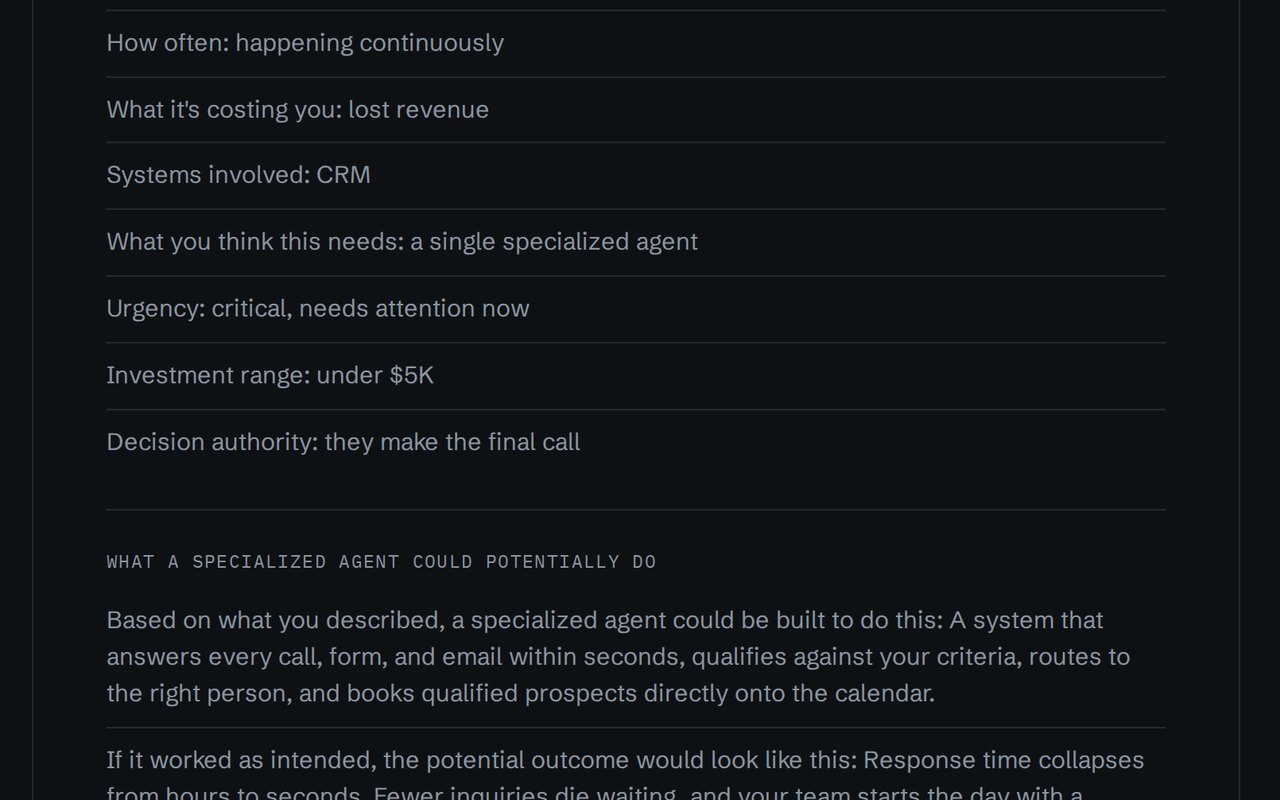
Every change we make writes a receipt.
This is the discipline underneath everything above, and it is the part that survives a change of staff. Our own fleet logs a record for every mission it runs: what was checked, what changed, what is verified as against merely inferred, and how to undo it. It is the same standard we would hold on your systems.
The receipt beside this is from a recent change to this website. It is the real format, with internal identifiers removed.
05 — Why Most AI Pilots Die
Agents do not work because the model is smart. They work because the engineering around them is.
A pilot dies for boring reasons: it never touched a real system, nobody owned it when it was wrong, and no one could prove whether it helped. The disciplines below exist to close those three gaps, and they are most of what an engagement actually consists of.
Which of your records, documents and policies the system can see at the moment it decides, and what it must refuse to answer rather than guess.
Written instruction that still holds when the customer is angry, the record is incomplete, or the request is one nobody wrote down.
The scaffolding around the model: tools, memory, retries, limits, and recovery when something fails.
Deciding which model does which step, and changing that as prices and capabilities move, without rebuilding the system.
Reading and writing your actual systems, including the ones with no API and no documentation.
Who approves what, what gets written down each time it runs, and who reviews the output other than the thing that produced it.
Instrumentation that proves the number moved, or tells you plainly that it did not.
Where each system lives, what it can reach, and how the whole set stays coherent as it grows.
06 — How It Gets Built
One method, start to finish.
AI Chief Strategies, the strategy practice in the same ecosystem, helps leadership decide what deserves to be built. We design, build, integrate, operate, and measure it. The two are designed to be used in that order.
What deserves to be built, what should wait, and why. Leadership judgment before a line of code.
The smallest system that does the job: workflow, trigger, systems, authority, handoffs, definition of done.
Production engineering on infrastructure we operate ourselves. Versioned, tested, reviewed, reversible.
Wired into the tools where your work already lives. Your workflow bends as little as possible.
Run, monitored, and supervised, with people over every consequential action.
Reported against the number it was built to move, plainly, whether or not it moved.
Systems get better on the job: reviewed, tuned, and given more authority as they earn it.
07 — Who You Are Buying From
We do not sell anything we do not run ourselves.
Our own company is operated by a fleet of specialized agents that plan work, build it, verify each other's output, and log a receipt for every mission. We learned the disciplines above there first, at our own expense. Several of them exist because something we built failed in a way we had not planned for, and the record of that is why the handoff gates are placed where they are.
Verified against internal Atlas records, 2026-07
Where We Sit
What we are, and what we are not.
OMEGABYTE runs several practices. They are genuinely different businesses with different buyers, and sending you to the wrong one wastes your money. If your problem belongs to one of the others, we will say so in the first conversation rather than the third invoice.
08 — The Next Step
Bring us the workflow. We will bring the system.
A conversation with us is thirty focused minutes on one business problem: which workflow would be handed over, what it would connect to, where the handoffs sit, what should change, and what it would take. No pitch deck. If we do not think it is worth building yet, we will say that instead.
Not ready to talk to a person? The diagnostic is a short set of questions and needs no email address to show you the result.
Direct principal involvement · Austin, Texas